|
|
|||
|
 |
Icons
Unlike the pictorial tradition that westerners have become accustomed to, the Russian icon tradition is not about the representation of physical space or appearance. Icons are images intended to aid contemplative prayer, and in that sense they're more concerned with conveying meditative harmony than with laying out a realistic scene. Rather than sizing up the figure in an icon by judging its distortion level, take a look at the way the lines that compose the figure are arranged and balanced, the way they move your eye around. If you get the sense that the figures are a little haunting, that's good. They weren't painted to be charming but to inspire reflection and self-examination. If you feel as if you have to stand and appreciate every icon you see, you aren't going to enjoy any of them. Try instead to take a little more time with just one or two, not examining their every detail but simply enjoying a few moments of thought as your eye takes its own course. The best collections of icons are to be found in the Tretyakov Gallery and the Russian Museum, though of course many Russian churches have preserved or restored their traditional works. The rising influence of European culture in Russia during the 17th and 18th centuries brought Russian artwork closer to the familiar traditions of western painting. It wasn't until the end of the 19th century that the next great body of uniquely Russian artistic styles arose, having developed in conjunction with liberal forces of social reform. This modern movement took many different directions almost from its inception, and it would be impossible to describe all of them. However, even a very general acquaintance with their common ideas and interests makes their work much more accessible.
From the end of the nineteenth century until about 1910, the modern art movement remained most interested in traditional aspects of Russian life--religion and village life were as influential as the life of the great cities. As the forces of social reform became more closely linked to the rising population of industrial workers, Russia's avant-garde artists turned increasingly to the factory and the frenetic pace of urban life for inspiration. Brilliant colours, simplified and sharply angular forms, and an emphasis on the liberatory energy of the modern world became the basis for new and increasingly abstract compositions. Cubo-Futurism, Rayonnism and Suprematism were the most important of the styles and schools that emerged during this time. Among their most prominent artists were Kasimir Malevich, Vladimir Tatlin, Mikhail Larionov, and Anna Goncharova. After the 1917 Revolution, the Russian Avant-Garde leapt into the service of the new Bolshevik regime. It seemed to promise just the sort of break into a new world, and sweeping away of the old, that they had been working for in art for years. They produced political posters, organized street pageants and fairs, and, most notably, carried out the design of the country's great public spaces for anniversary celebrations of the Revolution. Caught up in the new regime's emphasis on the importance of industrial power, they began to bring to composition a sense of the rationality and technological focus of industrial work and design. Constructivism, as this style is known, continued to evolve into the late 1920s, when the conservatism of the Stalinist state renounced the Avant-Garde in favor of Soviet Realism. Many of the prominent artists of the earlier schools played a central role in Constructivism, especially Tatlin. Other well-known artists of the Constructivist movement include Alexander Rodchenko, Varvara Stepanova, and Liubov Popova. Repudiated by the Stalinist government and neglected in the west, the Russian Avant-Garde has only recently received the attention it deserves. The Russian Museum in St. Petersburg possesses the finest collection of its work. Architecture
The centers of medieval church architecture followed the shifting dominance of old Russia's cities--from Kiev to Novgorod and Pskov, and, from the end of the 15th century, Moscow. With the establishment of a unified Russian state under Ivan III, foreign architecture began to appear in Russia. The first instance of such foreign work is Moscow's great Assumption Cathedral, completed in 1479 by the Bolognese architect Aritotle Fioravanti. The cathedral is actually a remarkable synthesis of traditional Russian architectural styles, though its classical proportions mark it as a work of the Italian Renaissance. The Russian tradition experienced a brief period of renewed influence under Ivan IV (the Terrible), under whose reign the legendary Cathedral of St. Basil's was built. In general, however, the Tsars began to align themselves increasingly with European architectural styles. The great example of this shift was Peter the Great, who designed St. Petersburg in accordance with prevailing European design. His successors continued the pattern, hiring the Italian architect Rastrelli to produce the rococo Winter Palace and Smolny Cathedral. Under Catherine the Great, the rococo was set aside for neoclassicism, completing St. Petersburg's thoroughly European topography. During the nineteenth century a fresh interest in traditional Russian forms arose. Like the associated movement in the visual arts, this revival of older styles participated in the creation of an avant-garde movement in the early twentieth century. For a brief period following the 1917 Revolution, the avant-garde Constructivist movement gained sufficient influence to design major buildings. Lenin's Mausoleum, designed in 1924 by Alexey Shchusev, is the most notable of the few remaining Constructivist buildings. By the late 1920s, the avant-garde found itself repudiated by Stalin's increasingly conservative state. Moving away from modernism, Stalinist-era architecture is best exemplified by the seven nearly indistinguishable "wedding-cake" skyscrapers that dominate the city's skyline. In more recent years, the dissolution of the Soviet state and a renewed interest in traditional Russian culture have produced a new appreciation of more modest folk architecture. The few remaining examples of traditional wooden architecture, such as those on display in the outdoor architectural museum in Kostroma, are now among Russia's most treasured architectural monuments.
|
 Russian
Art & Architecture
Russian
Art & Architecture 


 From icons and onion domes
to suprematism and the Stalin baroque, Russian art and architecture seems to many visitors
to Russia to be a rather baffling array of exotic forms and alien sensibilities. Without
any sense of the rich tradition of Russian culture, an appreciation of the country's
enormous artistic wealth becomes a game of historical anecdote--"the church where
so-and-so took refuge from what's-his-name"--or a meaningless collection of aesthetic
baubles--"I like the blue domes the best." In fact, Russian art and architecture
are not nearly so difficult to understand as many people think, and knowing even a little
bit about why they look the way they do and what they mean brings to life the culture and
personality of the entire country.
From icons and onion domes
to suprematism and the Stalin baroque, Russian art and architecture seems to many visitors
to Russia to be a rather baffling array of exotic forms and alien sensibilities. Without
any sense of the rich tradition of Russian culture, an appreciation of the country's
enormous artistic wealth becomes a game of historical anecdote--"the church where
so-and-so took refuge from what's-his-name"--or a meaningless collection of aesthetic
baubles--"I like the blue domes the best." In fact, Russian art and architecture
are not nearly so difficult to understand as many people think, and knowing even a little
bit about why they look the way they do and what they mean brings to life the culture and
personality of the entire country. 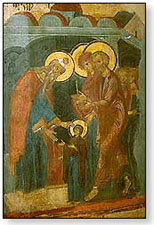 The tradition of icon painting was
inherited by the Russians from Byzantium, where it began as an offshoot of the mosaic and
fresco tradition of early Byzantine churches. During the 8th and 9th centuries, the
iconoclasm controversy in the Orthodox church called into question whether religious
images were a legitimate practice or sacrilegious idolatry. Although the use of images
wasn't banned, it did prompt a thorough appreciation of the difference between art
intended to depict reality and art designed for spiritual contemplation. That difference
is one of the reasons that the artistic style of icons can seem so invariant. Certain
kinds of balance and harmony became established as reflections of divinity, and as such
they invited careful reproduction and subtle refinement rather than striking novelty.
Although this philosophy resulted in a comparatively slow evolution of style, icon
painting evolved considerably over the centuries. During the 14th century in particular,
icon painting in Russia took on a much greater degree of subjectivity and personal
expression. The most notable figure in this change was Andrey Rublyov, whose works can be
viewed in both the Tretyakov Gallery in Moscow and the Russian Museum in St. Petersburg.
The tradition of icon painting was
inherited by the Russians from Byzantium, where it began as an offshoot of the mosaic and
fresco tradition of early Byzantine churches. During the 8th and 9th centuries, the
iconoclasm controversy in the Orthodox church called into question whether religious
images were a legitimate practice or sacrilegious idolatry. Although the use of images
wasn't banned, it did prompt a thorough appreciation of the difference between art
intended to depict reality and art designed for spiritual contemplation. That difference
is one of the reasons that the artistic style of icons can seem so invariant. Certain
kinds of balance and harmony became established as reflections of divinity, and as such
they invited careful reproduction and subtle refinement rather than striking novelty.
Although this philosophy resulted in a comparatively slow evolution of style, icon
painting evolved considerably over the centuries. During the 14th century in particular,
icon painting in Russia took on a much greater degree of subjectivity and personal
expression. The most notable figure in this change was Andrey Rublyov, whose works can be
viewed in both the Tretyakov Gallery in Moscow and the Russian Museum in St. Petersburg.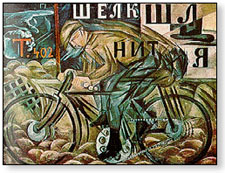 From the start, the modern art
movement was concerned with breaking away from the classical tradition and creating a new
kind of art that was intimately engaged with the daily life of Russian society. It
developed a renewed interest in traditional Russian art forms, including both decorative
folk art and, of course, icon painting. From decorative art it gained an appreciation of
the power of abstract geometrical patterns--lines, shapes, and color were used to
construct rhythms and energetic forms, not necessarily to depict objects or actual spaces.
The re-examination of icon painting made painters more aware of the power of a flat,
two-dimensional visual perspective. In other words, they realized that they could treat
the canvas like a canvas, rather than trying to give the impression that it was a window
into a space.
From the start, the modern art
movement was concerned with breaking away from the classical tradition and creating a new
kind of art that was intimately engaged with the daily life of Russian society. It
developed a renewed interest in traditional Russian art forms, including both decorative
folk art and, of course, icon painting. From decorative art it gained an appreciation of
the power of abstract geometrical patterns--lines, shapes, and color were used to
construct rhythms and energetic forms, not necessarily to depict objects or actual spaces.
The re-examination of icon painting made painters more aware of the power of a flat,
two-dimensional visual perspective. In other words, they realized that they could treat
the canvas like a canvas, rather than trying to give the impression that it was a window
into a space. 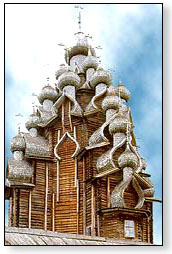 For most of its history, Russian
architecture has been predominantly religious. Churches were for centuries the only
buildings to be constructed of stone, and today they are almost the only buildings that
remain from its ancient past. The basic elements of Russian church design emerged fairly
early, around the eleventh century. The plan is generally that of a Greek cross (all four
arms are equal), and the walls are high and relatively free of openings. Sharply-sloped
roofs (tent roofs) and a multitude of domes cover the structure. The characteristic onion
dome first appeared in Novgorod on the Cathedral of Sancta Sophia, in the eleventh
century. On the interior, the primary feature is the iconostasis, an altar screen on which
the church's icons are mounted in a hierarchical fashion.
For most of its history, Russian
architecture has been predominantly religious. Churches were for centuries the only
buildings to be constructed of stone, and today they are almost the only buildings that
remain from its ancient past. The basic elements of Russian church design emerged fairly
early, around the eleventh century. The plan is generally that of a Greek cross (all four
arms are equal), and the walls are high and relatively free of openings. Sharply-sloped
roofs (tent roofs) and a multitude of domes cover the structure. The characteristic onion
dome first appeared in Novgorod on the Cathedral of Sancta Sophia, in the eleventh
century. On the interior, the primary feature is the iconostasis, an altar screen on which
the church's icons are mounted in a hierarchical fashion. 
 History